A few weeks ago, year 2 of Wild Wisdom School journeyed together into the desert monastic traditions through the familiar four fold vessel of the spirit, body, intellect and imagination. We have travelled to great distances and depths together, in the warm and loving space so generously provided each time by Juliette. I am so grateful for this space and for this vessel, and I am struck by the impact of simply turning up again and again, of committing to something and being with the turbulence of the road in companionship with one another. This is only my relationship to it however, and I feel completely trusting in the ‘rightness’ for those whose personal exit point is somewhere along the way.
The last time we met we crossed the ‘Jesus threshold’, which marks the point in our story when our present day calendar actually begins. This weekend we entered the world of the desert monastic movements, from the Essenes through to the Desert Mothers and Fathers. The Essenes were one of the three major sects at the time, alongside the Pharisees and the Sadducees. Discovery of their lives, through manuscripts such as the Dead Sea Scrolls, have provided us with our first example of monastic life; a life of commitment to spiritual practice and withdrawal from the civilised world. It is thought they lived a communal life dedicated to asceticism, voluntary poverty, and daily immersion. It is also thought by some scholars that Jesus had significant involvement with them, and many Essenes also became Christians after his death.
Later, in the sandy deserts of Egypt, we met the Desert Mothers and Fathers. Sometimes in community, and other times in solitude, these were people also dedicated to a simpler way of life away from the temptations of greed and power that gripped religious orders in the cities. Reading sayings that we have from them, I felt such alignment and companionship. I was struck with a sense that the spiritual community I relate to is not only contained to those I share space with today, but with those who have trodden a similar path of the heart right through the ages. I have often felt sadness that I don’t feel a particularly strong connection with my ancestry, something I think that plagues our culture as a whole. Reading the words of the Desert Mothers and Fathers pulled me into my ancestral lineage. These are my ancestors – my heart knows theirs.
Below are a couple of sayings from the Desert Mothers – Amma Sarah and Amma Synceltica (Amma translates as mother):
“If I prayed God that all people should approve of my conduct, I should find myself a penitent at the door of each one, but I shall rather pray that my heart may be pure toward all.”
“There are many who live in the mountains and behave as if they were in the town; they are wasting their time. It is possible to be a solitary in one’s mind while living in a crowd; and it is possible for those who are solitaries to live in the crowd of their own thoughts.”
The desert movement found its way to Europe predominantly though a Romanian monk named John Cassian who travelled to the Egyptian desert and spread the desert traditions throughout Europe in the 3rd and 4th centuries. During our quiet time together in the afternoon I chose to delve into the forest of books Sam generously offered to the space. I read further about John Cassian and discovered that his great work ‘Conferences of the Fathers’ was commissioned by an Irish bishop for the purpose of providing a methodical representation of the teachings of the desert wisdom. This Irish bishop was anxious about the unruly way these teachings, transported initially via their sayings, were being taken on by people of his land. The resulting manuscript that he commissioned formed the basis for monastic life as we know it today. It was picked up by St Benedict who based his monastic rule on this desert model while adapting it to western conditions. In fact, it wasn’t only a major shaping force for monastic life in Europe, but for European civilisation as a whole. The rule of Benedict inspired and sustained an alternative model of life. It was one of hard-working, economically self-sufficient communities conscious of their responsibilities to the world around them but practicing a gospel form of the radical detachment exemplified by the desert traditions. It was a model of life not taught by dogmatic uniformity, but rather through the power of example. And they were communities respecting difference with prayer and contemplation at the heart.
We are not a Benedictine community, but I feel very strongly the Benedictine spirit, and thus the desert spirit, living through our Wild Wisdom Community.
Ahh…. That’s a good feeling…. It’s like sitting in a supportive ancestral armchair….
As I had missed the Saturday’s gathering I had a feeling of being allowed into the cooking pot some hours after the process of creation had begun. All the ingredients had been picked and chopped, so that the stew was already bubbling nicely. I listened with awe. I had clearly missed a powerful day.
But Sunday was a wonderful day in it’s own right. We listened to Sam talking about the part of the calendar between Christmas and Easter. I learnt that 6th of January, as well as being Epiphany is also the date of the Baptism of Christ. As we listened we were invited to draw and sketch, I drew pools of water and moving into Easter the theme of cleansing seemed strong. We reflected on Ian Bradley’s presentation of Celtic Christianity as being about Presence, Poetry and Pilgrimage.
After that Sam took us on a contemplative walk. A short pilgrimage or our own. We walked in silence with our attention on all of our senses; through the village, past the ancient historical pub with meaty smells of lunch wafting through an open window, we squelched across fields, kissed at kissing gates, touched and smelt flowers and herbs, tumbling into the woodlands, scrambling over branches…to a pool of water, several of us felt watched there but who was watching us? And back through the woods and along the lanes to Juliette’s warm house where soup was waiting and Juliette and Janet had laid the table.
In the afternoon I introduced the group to some basic reflexology techniques. As a newly trained reflexologist it filled me with delight to see how much joy everyone took in an opportunity to learn and to simply touch, hands to feet. I read Hilary Llewellyn-Williams poem from her collection ‘Tree Calendar’ and for our date the tree was ‘Ash’.
‘In the encircled heart
Something vibrates from skin to skin – and how
Those blackstopped boughs curve upwards into blue,
Fingering the invisible stars of spring!’
Our day finished with silence and ceremony. We each spoke of what we wanted to include, what had felt important to us; there were stones and holes in stones and winds and birds and archways and wishes for the Spring….
I find myself struggling once again to write a journal article two and a half weeks after the weekend ended, if only I would sit and scribble straight away… but then that would be making life too easy for myself and I’m not very good at doing that!
Since the weekend, many conversations have been provoked, for good or worse, insightful or challenging, around the divine feminine and the sacred marriage. So where I am now is in these conversations, and not so much in the weekend itself. I look back at the journal post I wrote this time last year (found here) and I read the very deep revelation I had of meeting an unfamiliar and ancient story through a story of great familiarity – that being the story of Inanna and Demuzi through Sarah and Abraham. In fact it seems the biggest revelation was simply to hear something more of Sarah than only ‘Abraham’s wife’, which is how she is normally portrayed in the Bible. I am reminded through reading this of why it is important to be putting voice to the divine feminine, even though since the weekend I have been finding the term challenging for its risk of becoming conceptual and disembodied. As a female growing up in the Judeo-Christian world – particularly actually being brought up a Christian – it is easy to unconsciously take on the view that women are inferior. How can you not if all the stories you hear are about men who live interesting and full lives, and have important spiritual insights to share, while women are simply their wives? Not to mention the glaring fact that a male pronoun is used to refer to God, and male images to depict ‘Him’. Regardless of whether we have more female priests these days, if these priests are still telling the same stories, then we will still live the same old stories. For me, hearing the voice of Sarah was incredibly moving and inspiring because it reflects something to me – something about the stories of women being of value, being worthy enough to be in God’s house, being worthy enough to be remembered by us.
Who will make offerings at the altars and enact the sacred marriage that unites heaven and earth and keeps the land and its people fertile?… Sarah knows the old ways, secrets passed down from mother to daughter. So Sarah listens… and she remembers Inanna’s story…
Inanna’s descent to the underworld – a fierce and wild story and one that I relish with delight for all its curves and crevices, and motifs not acceptable to the present day image of the feminine. She is very very different to our quiet and unassuming Mother Mary, and I relish the contrast. What I love about mythology, as my experience grows, is the developing mosaic of images that these stories offer. I no longer only have one image of being a woman, rather I now have multiple images reflecting the multiple ways of womanhood – images of anger, of passion, of intimacy, of rejection, of joy, of lust, of love, of violence, the list could go on. They all speak to me on some level, and I feel more whole as a result. That doesn’t mean that I want to mimic the behaviours represented in mythology – who would do that?! But I feel more in touch with the different dimensions of myself, and more awake to how they manifest in relationship to the world around me. In the myriad representations of women in these stories, the wholeness of womanhood is acknowledged and honoured. The dark and the light are in relationship with each other. For me, this mosaic is very helpful to me as a human being trying to navigate this turbulent ocean of life.
This is only my perspective however. The lively discussion ensuing after Sam’s telling of Inanna showed how each experience of mythology is totally unique, and that really is the beauty of mythology. It doesn’t present us with a singular truth – ‘the moral of the story’ if you like. Mythology invites us into relationship, and no two relationships are ever going to be the same. The question is how we work with our different experiences as a group and as individuals… and that perhaps is a question at the core of Wild Wisdom School. Can we hold safe space for each other to journey along challenging paths and in these stony paths reap the collective wisdom? It’s certainly not easy, but the journey is fascinating to me.
I’m surprised I’ve actually managed to write something… as always I am saying to myself ‘next time, please try to write sooner so I can actually remember what happened’.


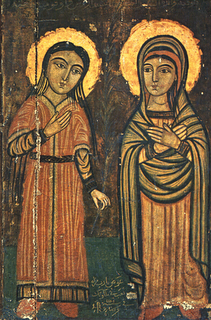 times in solitude, these were people also dedicated to a simpler way of life away from the temptations of greed and power that gripped religious orders in the cities. Reading sayings that we have from them, I felt such alignment and companionship. I was struck with a sense that the spiritual community I relate to is not only contained to those I share space with today, but with those who have trodden a similar path of the heart right through the ages. I have often felt sadness that I don’t feel a particularly strong connection with my ancestry, something I think that plagues our culture as a whole. Reading the words of the Desert Mothers and Fathers pulled me into my ancestral lineage. These are my ancestors – my heart knows theirs.
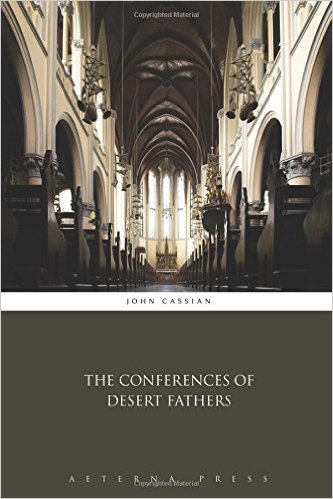 travelled to the Egyptian desert and spread the desert traditions throughout Europe in the 3rd and 4th centuries. During our quiet time together in the afternoon I chose to delve into the forest of books Sam generously offered to the space. I read further about John Cassian and discovered that his great work ‘Conferences of the Fathers’ was commissioned by an Irish bishop for the purpose of providing a methodical representation of the teachings of the desert wisdom. This Irish bishop was anxious about the unruly way these teachings, transported initially via their sayings, were being taken on by people of his land. The resulting manuscript that he commissioned formed the basis for monastic life as we know it today. It was picked up by St Benedict who based his monastic rule on this desert model while adapting it to western conditions. In fact, it wasn’t only a major shaping force for monastic life in Europe, but for European civilisation as a whole. The rule of Benedict inspired and sustained an alternative model of life. It was one of hard-working, economically self-sufficient communities conscious of their responsibilities to the world around them but practicing a gospel form of the radical detachment exemplified by the desert traditions. It was a model of life not taught by dogmatic uniformity, but rather through the power of example. And they were communities respecting difference with prayer and contemplation at the heart.
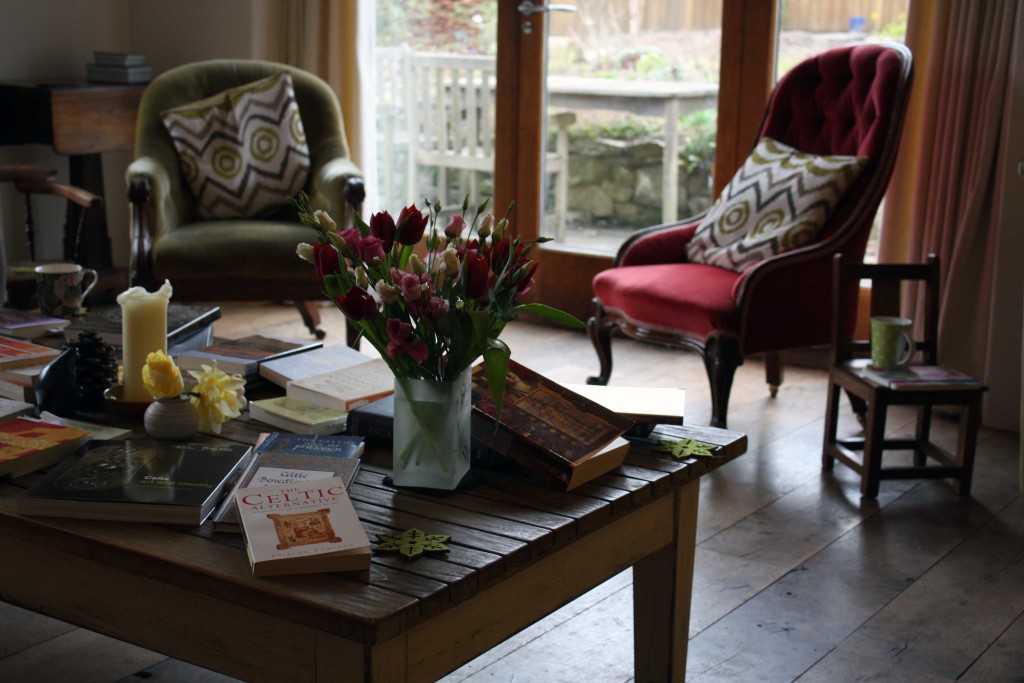
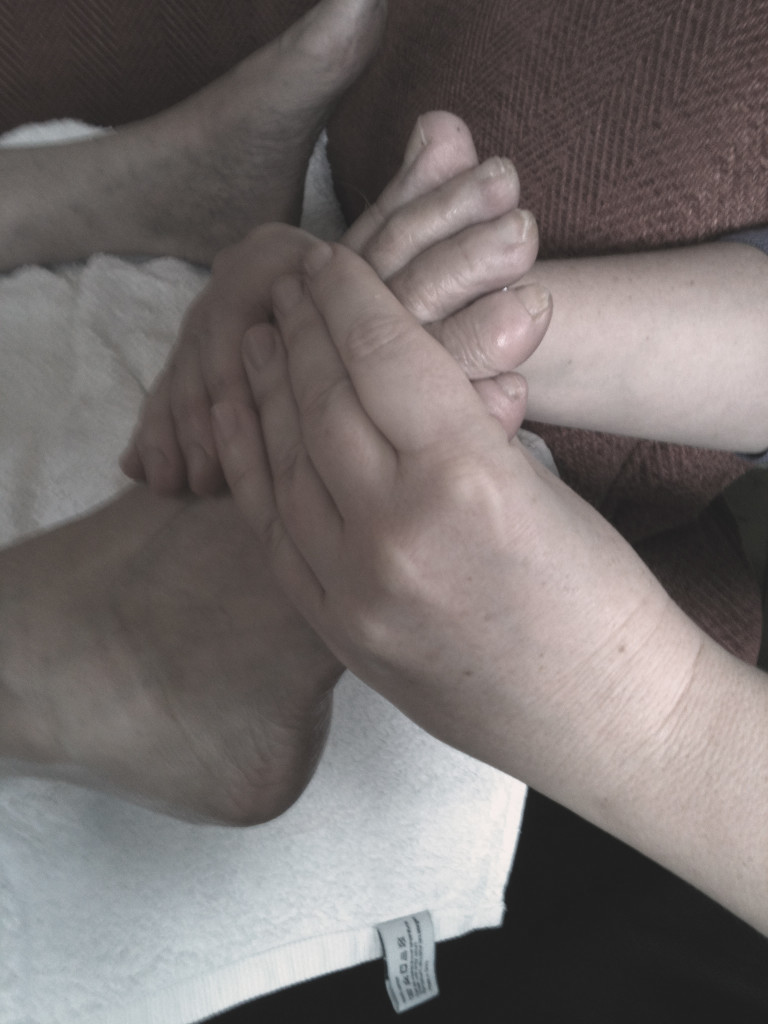 newly trained reflexologist it filled me with delight to see how much joy everyone took in an opportunity to learn and to simply touch, hands to feet. I read Hilary Llewellyn-Williams poem from her collection ‘Tree Calendar’ and for our date the tree was ‘Ash’.
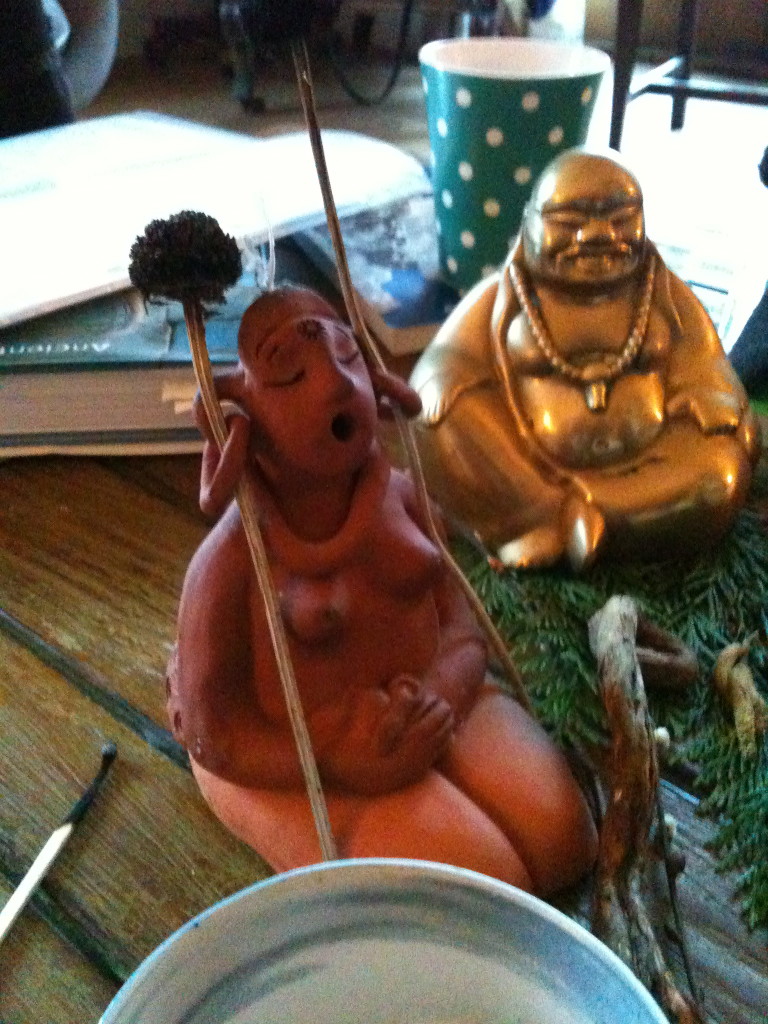 reminded through reading this of why it is important to be putting voice to the divine feminine, even though since the weekend I have been finding the term challenging for its risk of becoming conceptual and disembodied. As a female growing up in the Judeo-Christian world – particularly actually being brought up a Christian – it is easy to unconsciously take on the view that women are inferior. How can you not if all the stories you hear are about men who live interesting and full lives, and have important spiritual insights to share, while women are simply their wives? Not to mention the glaring fact that a male pronoun is used to refer to God, and male images to depict ‘Him’. Regardless of whether we have more female priests these days, if these priests are still telling the same stories, then we will still live the same old stories. For me, hearing the voice of Sarah was incredibly moving and inspiring because it reflects something to me – something about the stories of women being of value, being worthy enough to be in God’s house, being worthy enough to be remembered by us.
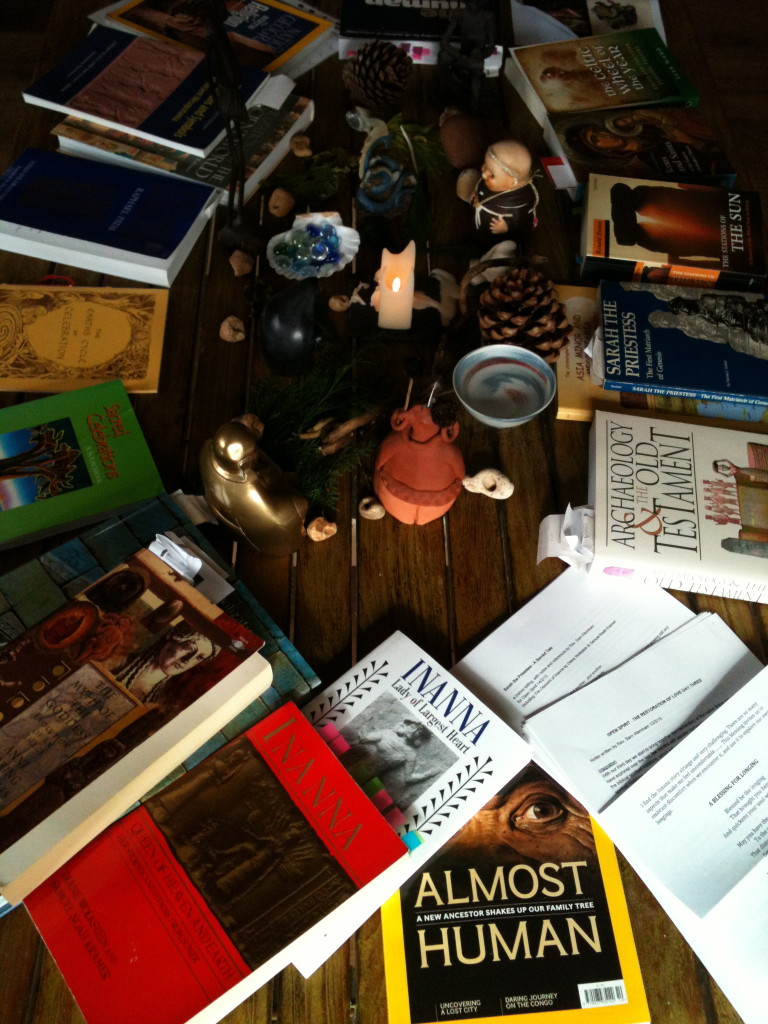 Inanna’s descent to the underworld – a fierce and wild story and one that I relish with delight for all its curves and crevices, and motifs not acceptable to the present day image of the feminine. She is very very different to our quiet and unassuming Mother Mary, and I relish the contrast. What I love about mythology, as my experience grows, is the developing mosaic of images that these stories offer. I no longer only have one image of being a woman, rather I now have multiple images reflecting the multiple ways of womanhood – images of anger, of passion, of intimacy, of rejection, of joy, of lust, of love, of violence, the list could go on. They all speak to me on some level, and I feel more whole as a result. That doesn’t mean that I want to mimic the behaviours represented in mythology – who would do that?! But I feel more in touch with the different dimensions of myself, and more awake to how they manifest in relationship to the world around me. In the myriad representations of women in these stories, the wholeness of womanhood is acknowledged and honoured. The dark and the light are in relationship with each other. For me, this mosaic is very helpful to me as a human being trying to navigate this turbulent ocean of life.
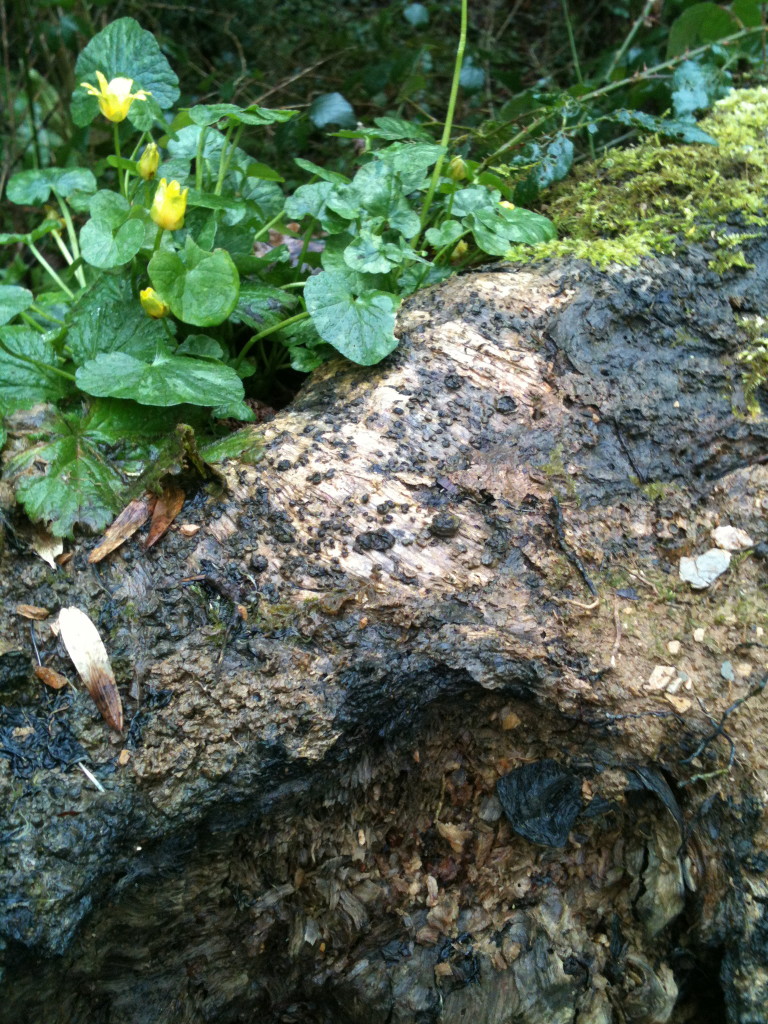 experience of mythology is totally unique, and that really is the beauty of mythology. It doesn’t present us with a singular truth – ‘the moral of the story’ if you like. Mythology invites us into relationship, and no two relationships are ever going to be the same. The question is how we work with our different experiences as a group and as individuals… and that perhaps is a question at the core of Wild Wisdom School. Can we hold safe space for each other to journey along challenging paths and in these stony paths reap the collective wisdom? It’s certainly not easy, but the journey is fascinating to me.


